
The short answer
Comal Inn shows a 15% direct booking code to two kinds of visitors only: someone who looks like they're leaving without booking, and someone who already checked dates and came back. Everyone else, including repeat guests, never sees it. The code goes into the booking link automatically, and each browser sees one offer a month at most.
Why not a discount for everyone
A code on every page gives money away to guests who were going to book direct anyway. Our repeat guests come back for the rooms, the location and an easy check-in, not a coupon.
The guest worth a discount is the one about to book the same room somewhere else. When we connected AI to our Google Analytics, it found two of them: people who checked our site, then booked the same stays on Booking.com for less. So we built an offer for that moment.
Who sees an offer
Someone who looks like they're leaving. On a computer, that's the mouse heading up toward the tabs, the address bar or the close button. It only counts after 20 seconds on the site, and only if they never tapped Book Direct.
The phone version. Phones have no mouse, so there's nothing to watch. Instead, if someone switches to another app or tab for at least 10 seconds and comes back without having tapped Book Direct, we treat that as comparing prices somewhere else.
Someone who checked dates and came back. Our booking page opens in a new tab. If a guest searches dates there and comes back to our site, either to the same tab after 45 seconds or on a later visit within 14 days, they see an offer with their own dates on it.
What they see

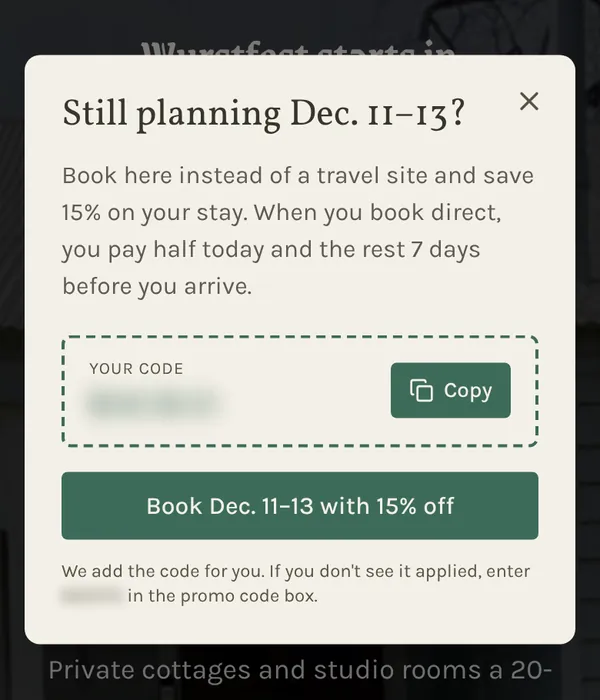
The leaving offer asks for dates, since the guest hasn't picked any yet. The came-back offer already has their dates, so booking them takes one tap. Both say what booking direct means for the deposit: half today, the rest 7 days before arrival. If the stay is within 7 days, that line doesn't show, since the full amount is due. (We've blurred the real codes.)
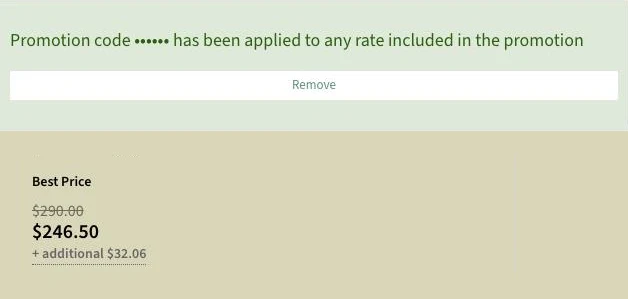
The code rides along in the booking link, so the guest never has to type it. If they wander the site after closing the offer and tap Book Direct later that week, the code still goes with them.
The rules that keep it polite
- Nothing for the first 20 seconds, so quick visits never see it.
- Nothing for anyone who already tapped Book Direct on this visit.
- One offer per browser every 30 days.
- No stacking. If a guest already has another code from us, like our Wurstfest one, they don’t get a second.
- Dates older than 14 days, or dates already past, don’t trigger the came-back offer.
- Never on our privacy page, and never for bots.
We can also open either offer on purpose for testing by adding a short code to any page address. Test views don't count in our numbers and don't start the 30-day clock.
What we store, and what we don’t
Everything the offer needs to remember stays in the visitor's own browser: when they last saw an offer, which code they got, and the dates they searched. None of it is sent to us. The only thing that leaves the browser is a count in our Google Analytics when an offer shows, gets closed or the code gets copied, with no name, email or dates attached.
The first nine days
Here's what Google Analytics showed in the first nine days:
- About 58 offers shown, split almost evenly between phones and computers
- 24 closed right away
- 10 codes copied, 7 of them on phones
Those counts include a handful of reveals and copies of our Wurstfest code, which uses the same tracking. People copying the code on phones makes sense. On a small screen, it's easier to copy it than to trust it'll carry over.
It's too early to say how many bookings it brought in. Our booking software doesn't pass the code into Google Analytics, so we'll count codes used in eviivo and update this note in a couple of months.
If you want to try this
- 01Start with one offer.The came-back offer is the easiest to justify. The guest already picked dates, so you know they’re serious.
- 02Put the code in the booking link.Check whether your booking software takes a promotion code in the link. Ours does, so guests never type it.
- 03Set a quiet period.One offer per browser per month keeps it from feeling like a sales pitch.
- 04Count three things.How often it shows, how often it’s closed, and how often the code gets copied or used. Then compare codes used in your booking software.
- 05Check the math.Make sure the discount still leaves you more than an OTA booking would. Our OTA commission calculator does the math.
Quick answers
Does exit intent work on phones?
Not the usual way, since there’s no mouse to watch. On a phone, we treat switching to another app or tab for at least 10 seconds and coming back as the sign someone is comparing options.
Won’t a pop-up annoy guests?
It can, which is why ours waits 20 seconds, never shows to someone who already tapped Book Direct, and shows each browser one offer every 30 days at most.
Does 15% off cost more than an OTA booking?
Usually not. On a $200 night, 15% off direct leaves about $165 after card fees. The same night through Booking.com, with a 10% Genius discount and a 15% commission, leaves $153.
Do you collect anything about the visitor?
No. Whether they’ve seen an offer and which dates they searched are saved in their own browser. Nothing about them is sent to us or anyone else.
How does the code get applied without typing it?
It’s added to the booking link. Our booking engine, eviivo, reads it from the link and applies it, even if the guest picks dates after they get there.
Want me to look at your site?
Send me your website. I'll tell you what I'd fix first, for free.